Air Hockey Basics – Under-the-mallet Banks

by Jacob Weissman

For this article I write from the perspective of a right-handed player, as I and most players are right-handed. If you are one of those rare, left-handed unicorns, simply think of my right hand as your left hand. For example, if I am talking about my right-wall banks those are essentially the same to me as your left-wall banks are to you.

There are two basic shots in the game of Air Hockey, the straight shot and the bank shot. Today I am going to focus on the bank shot. In its simplest form a bank shot is: any shot which bounces off of a rail of the Air Hockey Table.

When it comes to bank shots there are two basic types, an over-the-mallet bank shot (over) and an under-the-mallet bank shot (under). Today I am focusing on unders.

Unders:

The under-the-mallet bank shot is a fundamental Air Hockey shot. It is the quickest and most effective way to score underneath a mallet which is positioned in the middle of a goal to block a straight shot. An effective under-the-mallet bank should bounce only off of one rail (left or right) before entering the opponent’s goal. The reasoning for this is because of the purpose of unders. If we are trying to score under our opponent’s mallet, then we need our shot to score before our opponent can pull back and block our shot. Logically then, we want to send the puck on the shortest path to our opponents goal. In this case, the shortest path for a bank is from one rail to the goal, and not from one rail to another and then to the goal (aka. A double bank). The less time it takes for the puck to approach our opponent’s goal, the more likely we are to score.

To make the puck bounce off of the wall of our choice and under our opponent’s mallet, we must hit the puck at a steep angle with the rail. To best practice this, place a goal blocker or mallet over the goal corner closest to the rail you are using, and hit the puck until you get the angle down. Remember we want the puck to enter the closest corner of the goal. It may be difficult to get the right angle down, but, with enough practice, striking the rail in the right area becomes intuitive, locked down in muscle memory.

Once you feel comfortable with this angle, you then need to add the necessary power to the shot. Not only do we want the puck to enter the closest corner of our opponent’s goal, but we want the puck to do so quickly. A mistake many players make is attempting to create this power by lunging at the puck with their arm. This is ineffective for a couple of reasons. For starters it is too much power, and tends to knock the puck off the table, resulting in a wasted shot and, worse, a wasted possession. Secondly, in my experience, it is particularly difficult to aim with the arm. The shots that do not fly off of the table are just as likely to hit the rail at an unpredictable angle and miss the corner of our opponent’s goal, landing softly in the center of their mallet instead. While some arm motion is important to generate the force needed to drive an under home, for the reasons aforementioned, too much arm makes a shot unwieldy. For this reason, pro level players use their wrist to create much of the power necessary for a quick under, while maintaining the shot’s accuracy.

To strike the puck with a “wrist-powered” shot, simply snap your wrist in the direction you wish the puck to go as your mallet comes into contact with the puck. Done correctly, this snap of the wrist will give the puck enough energy to sail quickly into your opponent’s goal.

As there are two rails, the left and the right, there are thus two types of unders, the left-wall and the right-wall under.

The Right Wall Under:

By the following the basic rules I laid out above for unders, you should be able to execute an effective right-wall under. When it comes to where you strike the puck with your mallet, I have found the front right of the mallet the most effective area to strike the puck with in order to give the shot the “umph” it needs.

Effectively scoring the right-wall under does have one more, extremely important piece: time delays. In general, before you execute your under you want to “freeze” your opponent on defense, tricking them into staying out of position long enough for you to score. This is where time delays come in handy. By having your hand cocked and ready to let fly a right-wall under, as you drift the puck and put it into position to shoot, your opponent will be kept on edge, wondering when you are going to release. Often your opponent will unconsciously freeze their mallet in one spot in anticipation, like a deer in headlights. This gives you a perfect opening to score your shot, before your opponent has the chance to react and block the under. Throwing a couple pump fakes in the mix, acting like you are about to shoot the puck, but in actuality not, can help to make your opponent a perfect icicle on defense.

The Left Wall Under:

When it comes to the left-wall under, start by following the rules I laid out for all under-the-mallet banks. To create a consistently powerful and accurate left-wall under you still need to follow the mantra of more wrist and less arm. Snapping your wrist when executing a left-wall under will not only make the shot more consistently powerful, but it will also make the left-wall under more deceptive. Traditionally, a left-wall under is meant to look like a cross straight. Snapping your wrist toward the right as you execute a left-wall under can make the shot look similar to a cross-straight; as the mallet normally moves towards the right when a cross-straight is released. This similarity in execution helps to pull our opponent away from the corner of their goal closest to the left rail, where we hope to score. The top left corner of the mallet should hit the left side of the puck, sending it to the left rail, while the mallet itself snaps rightward. You want it to look like you are hitting the puck one direction when in actuality you send it in a completely different direction. If you find you are having trouble hitting the left-wall under, try positioning your body slightly to the right of the goal with your shoulders pointed toward the left rail. With your body positioned this way, finding the leverage you need to execute an effective left wall under should be easier.

As with the right-wall some time-delays can help to freeze your opponent on defense, allowing you to score. Pump fakes, however, become more interesting with the left-wall under. If you are making the unders execution look similar to that of a cross-straight, a pump fake can get your opponent to pull for a cross. This leaves their goal wide open for a crisp left-wall under.

Until next time…

Happy Shooting!

Posted in News | Comments Off on Air Hockey Basics – Under-the-mallet Banks

2015 Texas State Championships

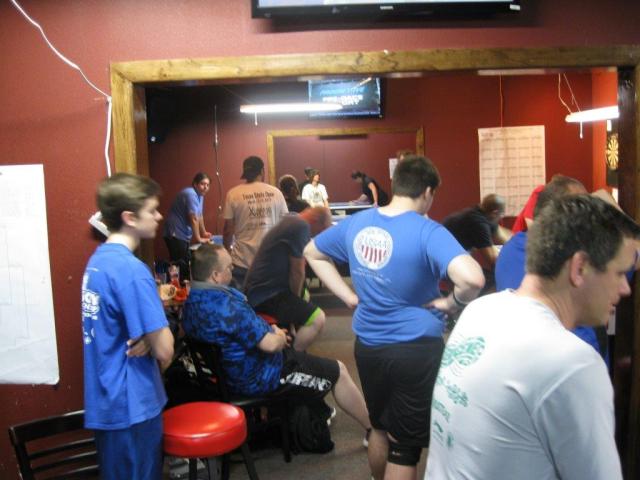
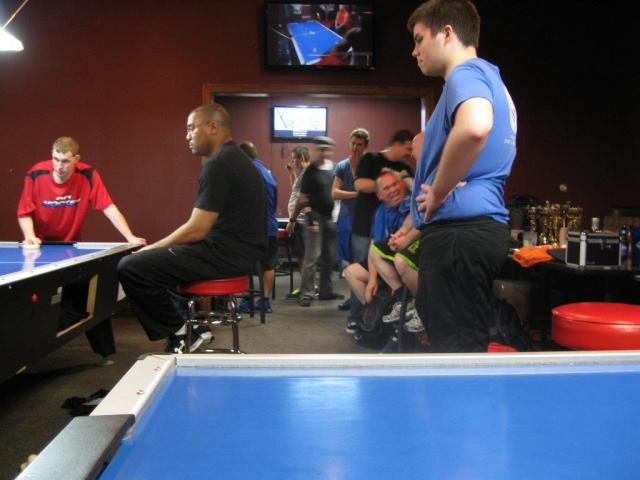
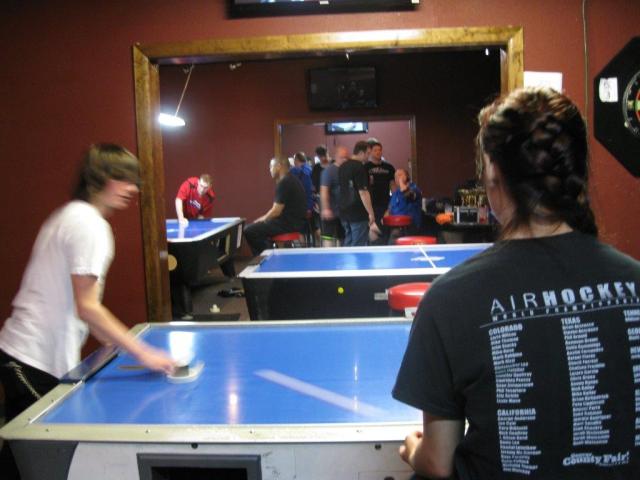
The Texas State Air Hockey Championships took place March 12-15 at Skybox Grill Bar & Games in Houston. The event was sponsored by Gold Standard Games, Xtreme Airhockey, and Skybox. Fifty two players competed in the main event with more entries in specialty events such as doubles, Press your Luck, and a handicapped tournament.

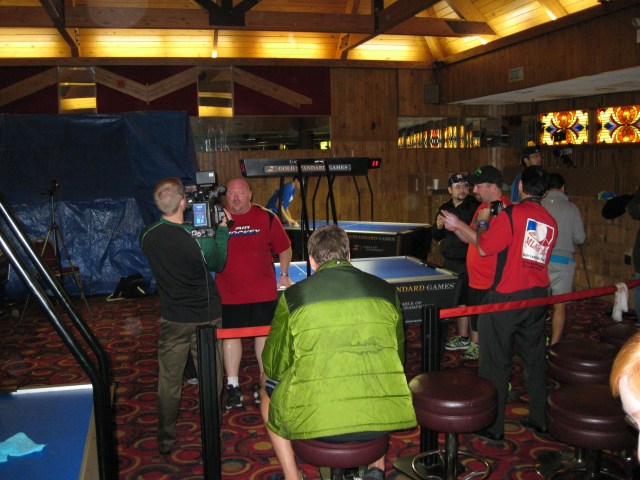
Winning the tournament was Colin “The Prodigy” Cummings of Houston. At just short of 16 years of age, Colin becomes the youngest player – by 3 years – to ever win a USAA-sanctioned major tournament. Second place went to former Texas champ Anthony Marino, followed by Brian Accrocco and Pete Lippincott. Fifth place went to another teenager, Avery Yebernetsky, a former USAA Junior champion. Media coverage of the event included a TV segment on Houston Channel 39’s NewsFix.

TX State 2015-1 TX State 2015-2 TX State 2015-3 TX State 2015-4

Posted in News | Tagged , | Comments Off on 2015 Texas State Championships

How to Play Air Hockey

A short, 6 minute introductory video showing some of the basic fundamentals of playing competitive air hockey. Features Mark Robbins, 2-time World Champion, 4-time holder of the USAA #1 Ranking, and owner of Gold Standard Games. At the end is a 30-second clip of Robbins winning his first National/World title.

Posted in News | Comments Off on How to Play Air Hockey

Douty vs. Dubuisson 1983 Boulder Nationals

Excerpts from what is considered one of the greatest matches of all-time in air hockey. This clip shows the end of the winners bracket match between Jesse Douty and Bob Dubuisson; followed by Paul Marshall interviewing Jesse; then the end of game 6 and the entire game 7 of the first set of the Finals. This match solidified Dubuisson’s reputation as the master of the comeback.

Posted in Historical Videos | Comments Off on Douty vs. Dubuisson 1983 Boulder Nationals

1985 Houston Nationals TV Clip

Another good TV clip featuring interviews with Robert Hernandez, Phil Arnold, Mark Robbins, and Bob Dubuisson.

Posted in Historical Videos | Comments Off on 1985 Houston Nationals TV Clip

1983 Houston Nationals TV Clip

This is one of the best TV news segments ever done on the sport of air hockey. Featuring interviews with Phil Arnold, Robert Hernandez, Jesse Douty.

Posted in Historical Videos | Comments Off on 1983 Houston Nationals TV Clip

First USAA Nationals 1978 TV Clip

Classic 4-minute TV news show segment from the very first USAA Nationals at Fair Lanes in Houston, TX. Features Ron Franklin interviewing Phil Arnold, Jesse Douty, Rolf Moore, Mike Barry, Mark Robbins.

Posted in Historical Videos | Comments Off on First USAA Nationals 1978 TV Clip

Billy Stubbs/Ehab Shoukry instructional video

A video of the instructional clinic conducted by Billy Stubbs and Ehab Shoukry at the 2013 World Championships has been uploaded to the new Gold Standard Air Hockey youtube channel! Billy was the 2012 World Champion and is a 3-time World Champ known for his extensive and comprehensive study of the game. Ehab Shoukry is a 2-time World Champ known for having one of the best defenses of all time.

This video is raw footage of the clinic, so it is unedited. The audio is not ideal because Billy and Ehab were not miked for the presentation, just a regular boom mike was used. Nevertheless there are valuable insights here for players at all skill levels. Billy focuses on offensive strategy and shot releases, while Ehab talks about defense.

Watch for more videos to be uploaded to the Gold Standard Air Hockey channel! Here’s the video, and you can also go to https://www.youtube.com/watch?v=7U6ZA4seopg

Posted in News, Videos | Comments Off on Billy Stubbs/Ehab Shoukry instructional video

Face-off Strategy

The following article was written by Jacob Weissman. It incorporates a 1996 article on face-offs by Don James, who might be called air hockey’s leading scholar of face-off strategy. 🙂 Note that Jacob’s article was written before the 2013 World Championships, so at the time of writing Billy Stubbs was World Champion.

Face-off Strategy, by Jacob Weissman

When we compare the Air Hockey of today to the Air Hockey of the 1990’s, it is easy to see that much has changed. The sport used to be based around careful, methodical deception. You beat your opponent slowly, as in a chess match, a tactic innovated mostly by Jesse Douty and then perpetuated by Tim Weissman in the early 90’s. After this, the Air Hockey textbook “tactic” became an incessant onslaught of deceptive attacks, like timed chess, meant to absolutely cripple your opponent, something innovated in part by Tim Weissman and then Danny Hynes in the early days of the new millennium. Today, Air Hockey stands on the precipice of a new innovation, the overwhelming, face-paced play style of Billy Stubbs. His new innovative style is not only extremely up-beat, based on fast drifts and faster release, but it relies mainly upon the positioning of the puck for deception. In the past the main forms of deception were time-delays and pump fakes, now more and more it is becoming about positioning. The theory is that if your releases are identical, and your tempo relatively upbeat, your opponent has no hope of keying in. Air Hockey is becoming more of a shoot-out now than a chess match. And yet, despite all this progress, there is one thing which has almost completely been lost in the fray: the face-off.

Facing-off is a lost art, and is relatively ignored by the Air Hockey community today. In the 90’s, around the time of its conception as part of the start of each match, it was thought of as a great addition to the sport, an excellent way to give an extra layer of strategy and depth to Air Hockey, a strategy and depth which has since been forgotten. Currently in the world of Air Hockey, only Ultra-pros, most of them from the era when the techniques were being innovated, and a select few current day pros, use many of these strategies on a regular basis. As for experts and below, and many pros as well, these strategies are practically non-existent. Most players only hit and block the puck during a face-off, and this needs to change. Players need to think about and practice how to face-off. It is an important part of our sport, dictating who gets that critical extra possession per match. At higher levels of play, this could give a player the one last point they need to win the match.
Yet, face-off strategy, rather than improving over the years, as have most aspects of Air Hockey, has rather degraded. This is something that could easily be improved, innovated just like the other aspects of Air hockey. All it takes is some attention from the community. In hopes that it will help inform the community, and save the neglected step-child of Air Hockey, the following is an excellent article by Don James written back in 1996. It outlines what were once considered to be the best “face-off” strategies. It is coupled with some current-day video examples of the techniques that Mr. James describes. Long live the face-off!

Rock, Paper, Scissors
Basic Face-off Strategy and Terminology
By: Don James, Jr.
Originally written in Volume 18, Issue 2 of Table Talk (Fall 1996):

The USAA has decided to begin every set with a face-off instead of a coin flip, at all sanctioned tournaments. The rule was a long time in the coming, but it will finally lend an element of skill, and not just luck, in determining who gets one extra possession per match. Players winning the initial face-off will begin with the puck in the 3rd , 5th, and 7th game. The centerline rules governing as face-off were also changes; the rules now state that a player’s mallet cannot come in contact with the centerline until after the referee releases the puck, at which point normal centerline rules are in effect. To master the face-off a player must possess lightning-like quickness, eerie intuition, superb fundamentals, and a vast and versatile repertoire of maneuvers. At the highest level of Air Hockey, the face-off is like a game of “rock, paper, scissors.” Every technique has its own strengths and weaknesses; certain maneuvers and tactics will always work against certain others. There are five basic strategies or “openings” used in the world of air hockey today. They are as follows:

Standard Opening- The easiest face-off strategy to use and learn is the standard opening. Simply put, all it is, is a basic shot (usually a bank shot) taken upon release of the puck. A normal (backhand) or a forehand bank is the most common shot attempted, although a double-bank can sometimes be employed ( especially effective against a poorly executed crowd opening). A quick release is vital to successfully using this technique. Long “Mike Barryesque” wind-ups before a shot are not acceptable, and if the opponent is using a standard opening of his own it will usually result in your being scored upon. Straight shots can also be effective, particularly against slower standard openings. The “crock shot,” invented by Brian Accrocco, is a push straight shot executed with no wind-up at all. This maneuver was developed to counter the Australian opening and more specifically the “Weissman pull.” The standard is the only one of the five basic openings which offers the possibility of a score, the others are just techniques to gain possession. Overall, the standard opening is the strategy which should be employed most often, for beginners and professionals alike .

Australian Opening- the Australian opening (invented by Tim Weissman) is one of the best face-off maneuvers used today. In fact, the rules of the face-off were changed to limit the effectiveness of this very move. To execute the Australian, the player positions his mallet with a forehand grip directly behind (or maybe a little bit offset to the right) the puck. When the puck is released the player moves his mallet to the right of the puck at the centerline and then pulls his mallet to the left in a forehand motion, causing the puck to be pulled onto his side. The Australian is used to gain possession, it is not a scoring strategy. The Australian opening is all about quickness and anticipation. One drawback to the technique is that the less the maneuver is telegraphed at the outset, the harder it is to successfully accomplish. If the player starts (or even moves) to the right of the puck before the release, his opponent will no doubt know what is coming. The counter to the Australian is a quick standard opening, and specifically a “crock shot.” Australian vs. Australian results in a hand-smashing test of speed. An Australian opening is unstoppable against an Invitational or Crowd opening. The reverse Australian opening is performed from the backhand side, while the “Weissman pull” starts with the mallet in position and the hand cocked to the side of the puck. The Australian opening should not be employed by Amateur or below players against superior competition.

Invitational Opening- the idea behind the Invitational opening is to force (or invite) your opponent to take a poor shot and then defend it. To execute the Invitational opening the player merley pulls back to his goal. The average shot taken off a face-off release is not nearly as hard to stop as a set-up shot, and therefore if one can get in defensive position fast enough, the Invitational is a deadly opening. A Siegeworth opening or overly aggressive Crowd opening is always defeated by the Invitational. This maneuver is very effective against lower skilled players, who tend to make poor contact with the puck upon release. The Invitational opening is also a very safe maneuver for beginning players to use.

The Crowd Opening- The strategy behind the Crowd opening is to block the puck, forcing a deflected shot, which should rebound harmlessly on your side of the table. When the puck is released the player moves forward within 1/2” of the puck, in order to make contact with the puck after it is contacted by the opponent. The contact must not be direct or the puck will rebound straight back to the opponent’s side. The Crowd’s ideal use is to cut off the bank angles used in standard opening. The “Cabot Stand,” invented and used by Tarl Cabot, is a Crowd opening executed from the starting of 1 to 1/1” back. The distance from the puck in the “Cabot Stand” allows for an Invitational opening type “get” if the opponent clips the puck while still cutting off the bank angles with a slight reactionary adjustment. However, the double bank is wide open and an Australian becomes even more effective. The Crowd opening will usually defeat the more passive Invitational opening because the puck stays closer to the mallet during the Crowd, allowing for a quick switch to an Australian pull or standard shot. This opening is effective against all levels of competition, but should be avoided against players who prefer the Australian opening.

Siegeworth Opening- The Siegeworth opening, invented by Evan Siegeworth, was developed primarily to defeat Crowd-type openings. To execute the Siegeworth opening the player shoots the puck directly into his opponent’s mallet in order to have the puck rebound back to him. The release of the puck should be a quick tap or flick type of shot executed from a straight-up position. If the player is quick enough, the Siegeworth opening can defeat any opening except for the Invitational, which will usually result in an easy give away. The Siegeworth is an advanced technique recommended for experienced players only.

Even knowing all of these techniques, the key to face-offs lies in the execution. Intimidation, anticipation, knowing your opponents tendencies, bluffing, and knowing how to deal with the false start are areas which play a role in more advanced strategy. The invention of new openings and derivatives of these will no doubt lead to better and more exciting air hockey.

————

Examples:
Siegeworth open: http://vimeo.com/album/2299270/video/61643219 In this clip, world champion Danny Hynes quickly taps the puck off of Billy Stubbs’ mallet before Stubbs can even react, reflecting the puck so that he Hynes gains an easy possession. Here we see Danny exemplify what it is to simply move faster than your opponent, contacting the puck before they do. This is a basic fundamental of the face-off, especially when attempting the Siegeworth Open, which thrives on speed and finesse.

Crowd Open: http://vimeo.com/album/2299270/video/61643293 By keeping his mallet about 1” from the puck, Dan Meyer is able to deflect Danny Hynes’s attempted Standard opening and “get” the puck.

Australian Open: http://vimeo.com/album/2299270/video/61643294 Here Dan Meyer uses the Australian open to “pull” the puck quickly to him before Romero Castano can even hit the puck. Notice that, although he pulls the puck with a quick forehand like movement, he is not over to the left of the puck, as one does with the “Weissman Pull”, and thus not telegraphing his planned open. Doing this though requires a speed and finesse which many lack, again, a basic fundamental when it comes to facing-off, no matter what open you attempt.

Invitational Open: http://vimeo.com/album/2299270/video/61643222 As soon as the puck is released Albert Ortiz retreats from the puck and “invites” Brian Accrocco to take a shot, which ends up becoming an easy capture for Ortiz as the accuracy and speed of a shot, among other things, taken from a normal face-off position is usually significantly poorer than is the speed and accuracy of a “normal” shot.

Crock Shot: http://vimeo.com/album/2299270/video/61643221 Here Travis Luscombe simply pushes the puck forward before Paulo Correia can “get” it with his attempt at an Australian open. By swinging past the puck to the left without grabbing the put, Paulo leaves his goal wide open, giving Travis an easy score with his quicker standard open. As we have seen with every past successful open, Travis’s standard works only because he is faster than Paulo; despite the fact that the pushed straight “crock shot” works well against the Australian open, Paulo would most likely have still captured the puck if he was able to make contact with it before Travis.

Posted in News | Comments Off on Face-off Strategy

2013 World Championships

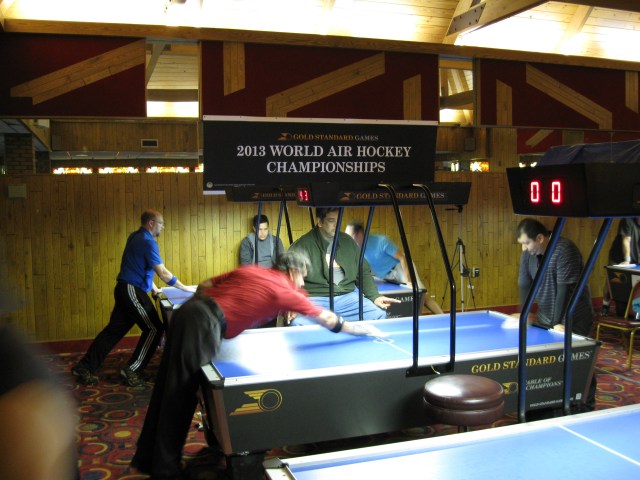
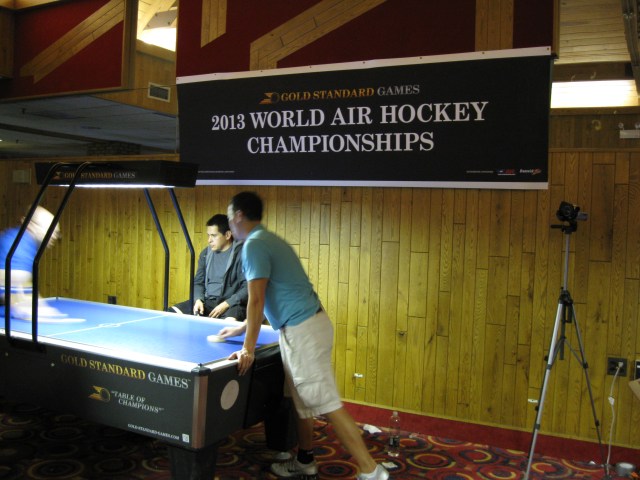
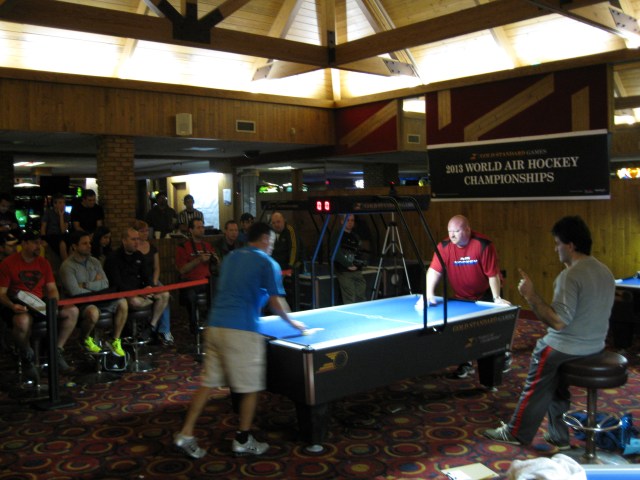
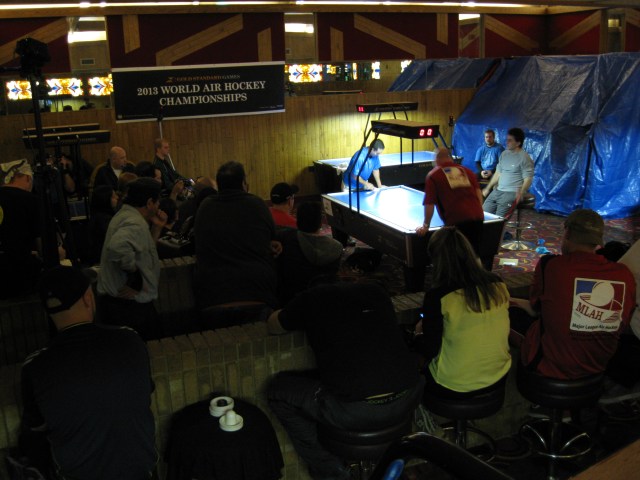
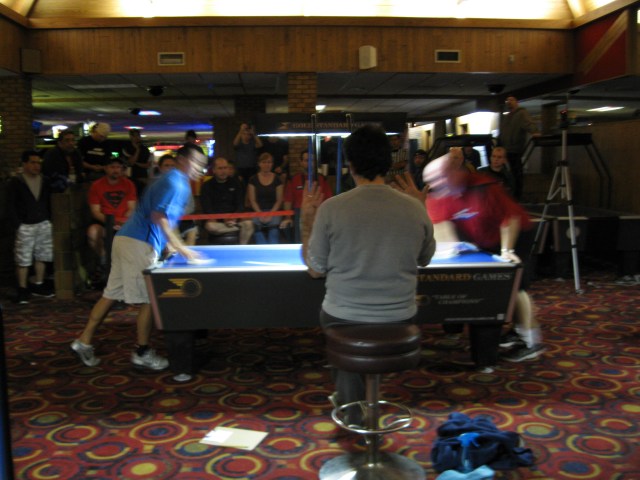
Air Hockey’s World Championship took place Oct. 17-20 at the Brunswick Zone in Naperville, IL. The event was sponsored by Gold Standard Games and World Championship Air Hockey. This was the 53rd World/National championship sanctioned by the USAA, starting with the first in 1978. And it was the first Worlds to be played on Gold Standard Games tables.

Danny Hynes of Houston won his record-tying 11th World title in typical fashion for him: he had to fight his way through the losers bracket after being put there by Davis Lee of California, who beat him 4-2. Davis also beat 2012 Champion Billy Stubbs, who was the favorite coming in to win the tournament. So Davis was on top of the winners bracket waiting for whoever emerged from a tough losers bracket.

Pedro Otero, who had captured the #1 World Ranking earlier in the year by beating Stubbs in a challenge match, suffered a surprise defeat early on to fellow Venezuelan Javier Pulido. Pedro managed to fight his way back to a 3rd place finish, along the way defeating 4 former World Champs: Mark Robbins, Tim Weissman, Ehab Shoukry, and Billy Stubbs. Pedro was finally stopped by Danny Hynes in an exciting battle that went down to the final 7th game.

Davis had come into the tournament at the top of his game, having beaten both Ehab Shoukry and Danny Hynes in USAA challenges matches in the month before the tournament. So Davis came to the Worlds ranked #2 by USAA, although his seed and rating was only #4 due to differences in the Ranking and Ratings systems. But unfortunately for Davis, Danny was like the “Danny of old”, catching fire in the losers bracket and playing with great intensity with his back against the wall. Danny dropped only 2 games in beating Davis two sets to capture the title.

Billy Stubbs finished 4th after being knocked out of the tournament by Pedro Otero, his nemesis who beat him in February in that challenge match. Fifth place went to former Champion Ehab Shoukry, followed by Brian Accrocco. Finishing 7th was 14-year-old prodigy Colin Cummings of Houston, the youngest player ever to finish Master (top 10) in a World/National tournament. Earlier in the year Colin had become the youngest Master via a challenge match victory.

Rounding out the top 10 were August Parra, 8th; Tim Weissman, 9th; and Javier Pulido, 10th. Mike Cummings of Houston won the 17-24 bracket. The 25-32 bracket winner was Dionisio Diaz of Venezuela, and Houston’s Donovan Brown won the 33-48 bracket. Junior Champion (highest finisher 16 and under) was Colin Cummings.

The Friday night Doubles Championship was won by Danny Hynes and Ehab Shoukry. On Thursday night, Chris Aston of Dallas won the Handicap (point-spot) event.

In winning his 11th World title, Danny Hynes tied the long-standing record of Jesse Douty. Jesse won 11 titles between 1978 and 1988. He was dethroned in 1989 by Tim Weissman, who went on to win 10 titles of his own. Danny pulled ahead of Tim by winning this year’s Worlds.

To see more details on the 2013 Worlds, got to http://www.airhockeyworld.com (or http://www.airhockey.com) and you can see charts and individual match details. Videos from the tournament should be online soon, check back for details.

Phil Arnold unleashes a shot

Phil Arnold unleashes a shot

IMG_0530

Tim vs. Davis

Tim vs. Davis

Danny vs. Pedro

Danny vs. Pedro

Davis vs. Danny

Davis vs. Danny

IMG_0547

Danny TV interview

IMG_0560

Danny TV interview

Pedro, Danny, Davis

Pedro, Danny, Davis

players from Spain, U.S., Venezuela

players from Spain, U.S., Venezuela

Posted in News | Comments Off on 2013 World Championships